Walsh Graduate Research Fellowship 2026-2027
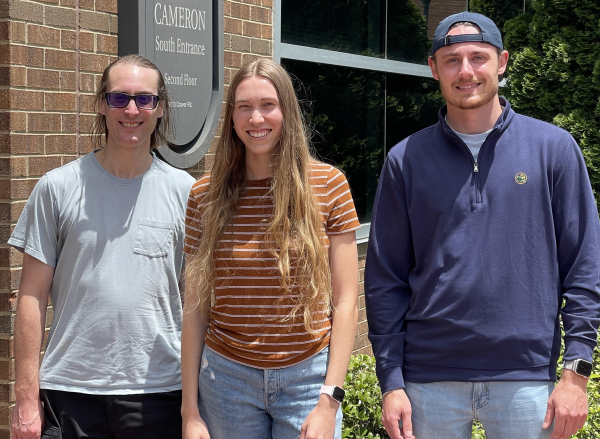
The Thomas D. Walsh Graduate Research Fellowship, made possible by the generous support of Dr. Thomas Walsh, recognizes outstanding contributions by M.S. candidates to graduate research. Typically, returning graduate students are eligible for this prestigious award after their first year. The Thomas D. Walsh Graduate Research Fellowship supports the winner with a research assistantship and tuition support through their second year.
We are congratulating the Thomas D. Walsh Graduate Research Fellow Alyssa V. Jones! We will briefly recognize Alyssa during the new graduate student reception on Friday, August 14 at 12:30 PM in Klein Hall (2nd Floor Lobby), and honor the awardee during the Walsh Graduate Student Reception 2026 (TBA).
Alyssa V. Jones, originally from Danville, VA, attended Averett University where she earned her B.S. in Chemistry with a concentration in Biochemistry and a double minor in Biology and Music in 2025. During her time at Averett, she played on the women’s soccer team, earning the Highest Female Athlete GPA each year. Alyssa was an Academic Success Tutor at the university, tutoring students in physics, general chemistry, organic chemistry, and music. She also interned at Arkema in Chatham, VA, where she worked in their quality control lab performing control testing, processed and in-process testing. She analyzed data and worked with a variety of analytical instruments including viscometers, titrators, HPLCs, LCs, and GCs. At Arkema, she also worked on an engineering and sustainability project where she designed processes to evaluate heat and energy loss. Alyssa began pursuing her Master of Science in Chemistry at UNC Charlotte in the fall of 2025.
Alyssa joined the group of Dr. Christopher Bejger and is interested in rechargeable energy storage systems. The latter are essential for the deployment of renewables, such as wind and solar, at the grid and microgrid scales. Redox flow batteries (RFBs) are energy storage devices that offer an alternative to lithium-ion batteries for grid-scale applications. The Bejger group has previously reported substituted-radialene compounds as organic catholytes for use in aqueous RFBs. However, aqueous RFBs suffer from low operating voltages. Thus, radialene catholytes for use in non-aqueous redox flow batteries (NARFBs) with expanded potential ranges are currently being explored. Amide-functionalized radialenes have previously been shown to exhibit high-capacity retention but low solubility in NARFBs. The Bejger group aims to synthetically tailor these species to exhibit higher solubility while retaining favorable capacity retention. In parallel, the group is investigating electron-withdrawing sulfonyl groups for next-generation radialene catholytes with higher voltages and developing radialene ionic liquids for use as catholytes with high energy densities. Ionic liquids can be tuned to have lower viscosities and more miscibility with organic solvents. Such active species require less solvent and are thus attractive for developing more sustainable NARFBs.
The Department of Chemistry is also proud of the other two finalist: Bryan W. Fulghum and Alexander E. Page. Their brief biographical sketches and research abstracts are given below.
Bryan W. Fulghum from Cary, NC, has an interesting and diverse background, having worked as an arborist, restaurant server, solar electrician, and local politician in his hometown. He eventually decided to go back to school at UNC Charlotte to major in biology. He got involved in research very early, pursuing undergraduate research on improving PCR primer design for multi-sequence alignments and on using blind deconvolutions to perform viral counts on epifluorescence microscopy images.
After Bryan joined the Chemistry Master’s Program to work in the group of Dr. Michael Walter. There he is testing the potential of Cepharanthine and its chemical derivatives as a treatment for the measles virus, combining a data-driven computational approach with experiemtnal synthetic work.
Alexander E. Page was born and raised in Sweden to a Swedish mother and British father. He competed as a junior professional ice hockey player before transitioning to collegiate athletics in the United States. As an NCAA student-athlete, he represented Missouri Southern State University in golf, earning two MIAA Conference Championship titles and setting a course record of 63 (-8). Perusing a higher education in the US after his move in 2001, he earned a Bachelor of Science in Chemistry Forensic Science from Missouri Southern State University. Outside of research, he enjoys golfing, cooking, and spending relaxing evenings with friends.
He is currently conducting research in the Dr. Laura Casto-Boggess research laboratory with his thesis project focusing on the development of portable analytical platforms that integrate microfluidic capillary electrophoresis with surface-enhanced Raman spectroscopy (SERS) for high-sensitivity molecular detection and biosignature identification.
The search for extraterrestrial life remains a major objective in planetary science, with icy moons such as Enceladus recognized as prime targets for biosignature exploration. Advancing analytical technologies capable of detecting molecular biosignatures is therefore critical for future planetary missions. This work proposes the integration of microfluidic capillary electrophoresis (CE) with surface-enhanced Raman spectroscopy (SERS) to achieve rapid separation and highly sensitive identification of amino acids. SERS exploits localized surface plasmon resonance (LSPR) to amplify inherently weak Raman scattering by enhancement factors of up to
10¹⁰ – 10¹², providing exceptional sensitivity while preserving molecular fingerprint information. A 200 × 200 μm microfluidic channel requiring only microliter-scale sample volumes enables a compact, low-volume analytical platform compatible with portable Raman instrumentation. The combination of microfluidic CE for high-resolution separations and online SERS for molecular identification establishes a portable strategy for biosignature detection with significant potential for future astrobiological exploration.